Shopify CRO: more revenue from the traffic you already pay for.
Most stores that struggle to convert are not short of visitors. They are short of answers: where, exactly, do shoppers leave, and why? We find out from your own data, session recordings and tracking, fix the biggest leaks first, and measure the result against a baseline we write down before we start. We are a conversion rate optimisation agency for Shopify brands, and we start from your own data, not a checklist.
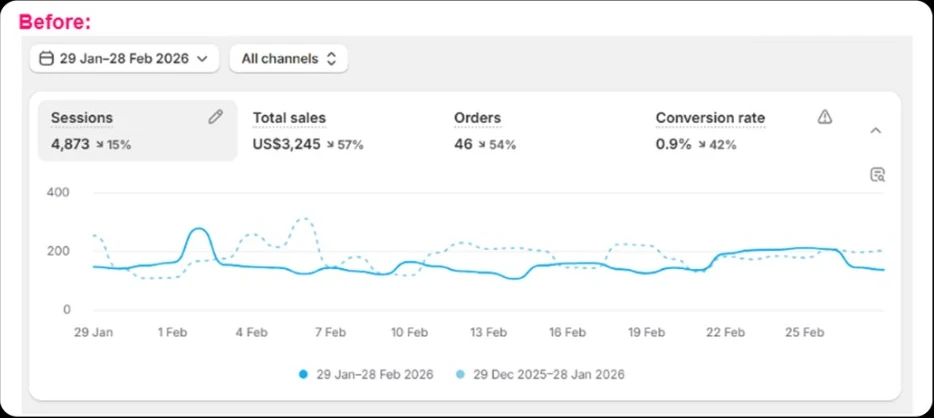
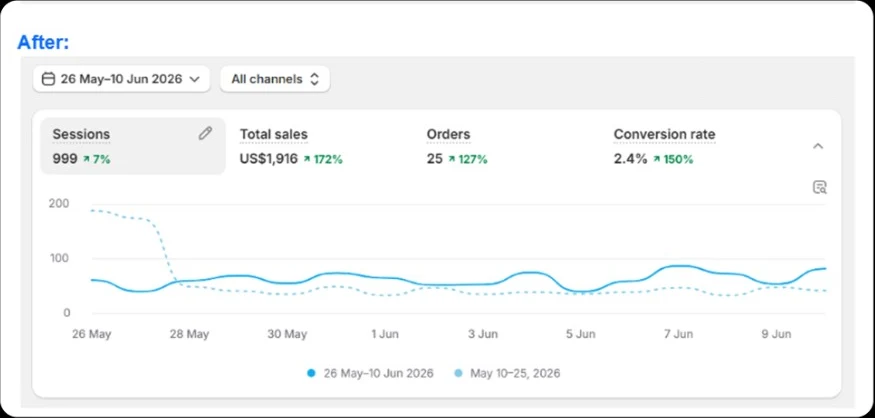
+167% CVR within 14 days · Lhasa Remedy, a US wellness brand · 0.9% to 2.4% (Shopify Analytics)
Founder-led. Month to month. Fixes live from day 15 (our standard CRO timeline).
A low conversion rate is a symptom. These are the causes we find most, with what we found at Lhasa Remedy.
The numbers are wrong
If tracking is broken, every decision is a guess. At Lhasa Remedy, the add-to-cart trigger fired on page views instead of button clicks: Google Analytics showed 181 purchases against about 20 real orders, a 9 times gap. We rebuilt the tracking first, because no optimisation is valid on broken data.
Shoppers click on things you cannot sell
Of 62 sessions with add-to-cart intent, 29 (47%) hit a sold-out product. No page redesign fixes that. Inventory is part of the funnel.
Mobile visitors never get far
Mobile was 69% of the traffic but shoppers scrolled only 25% of the page on average, with 274 dead clicks and 197 quick backs. The first screen was losing them.
The traffic is not paying its way
Ads and email can leak before the shopper reaches your product page: a store buying clicks at a loss, an abandoned-checkout email nobody clicks. We audit them where they affect conversion and tell you what to fix. We do not run your ads or your email.
Changes are made on opinion
New banners, pop-ups and urgency timers get added because they feel right. Without a hypothesis and a baseline, nobody can tell whether any of it worked.
What the forensic CRO audit and programme include
This is what a conversion rate optimisation agency should deliver.
01
104-point forensic audit
A structured review of your funnel against 104 checks, from the first screen to the thank-you page, scored so the biggest problems come first.
02
Tracking audit and repair
Google Analytics 4 and Google Tag Manager checked event by event and rebuilt where they are wrong, so the numbers can be trusted.
03
Session recordings and heatmaps
We watch real sessions in Microsoft Clarity and read the heatmaps, to see where shoppers get stuck, hesitate or give up, and what your analytics cannot show.
04
Fixes ranked by impact
Every fix is scored for potential, importance and ease (PIE), so the changes that move revenue most, for the least effort, ship first.
05
Tests and measured changes
Each change starts with a hypothesis and is measured against your baseline. Where your traffic is large enough we run a proper A/B test. Where it is not, we say so and measure before and after.
06
Funnel and order value
Product page, cart and checkout improvements, plus upsell, cross-sell and bundle ideas that lift average order value, reported in plain numbers.
When search is the bigger lever for your store, we pair CRO with SEO and AI SEO. Starting with CRO is usually the cheapest way to find out.
How it works
1Before you commit
1. Diagnose
A free 30-minute diagnostic. We share your Shopify store on screen and name two or three conversion leaks live, and tell you whether they are worth fixing. No pitch.
2Days 1 to 14
2. Audit
The 104-point audit, the tracking check, session recordings and heatmaps. We agree your KPIs with you before work starts and record your baseline in writing by day 14.
3From day 15
3. Fix
The first fixes go live from day 15, ranked by impact and effort. Conversion-rate movement is expected within 30 days. (This is our standard CRO timeline.)
4Month 2 on
4. Compound
Each result feeds the next hypothesis. Winners stay, losers teach, and every month's report ties the change to revenue.
The result: +167% CVR within 14 days
Lhasa Remedy, a US wellness brand
0.9%
Before: 29 January to 28 February 2026
2.4%
After: 26 May to 10 June 2026
Lhasa Remedy, a US wellness brand, had converted at 0.9% (Shopify Analytics, 29 January to 28 February 2026). Within 14 days of the fixes going live, including the rebuilt tracking and the sold-out inventory fix, its conversion rate rose from 0.9% to 2.4%, an increase of 167% (Shopify Analytics, 26 May to 10 June 2026).
What we found along the way: broken tracking, almost half of add-to-cart intent hitting sold-out products, a dormant email channel, ads below break-even, and a mobile experience that lost shoppers on the first screen.
Before: 29 January to 28 February 2026After: 26 May to 10 June 2026
Source: Shopify Analytics, all channels. Conversion rate is the share of sessions that ended in a purchase, as Shopify Analytics reports it. The two periods are different lengths (30 and 16 days). The percentages shown inside each screenshot compare that period with the one just before it, not with the other screenshot.
Why Prism3
Forensic, not a template
No pop-ups, urgency timers or exit-intent overlays pasted from a checklist. We start from your data.
Tracking first
We never optimise conversion on broken tracking. If the numbers cannot be trusted, fixing that is step one.
Founder-led
The person who runs your audit runs your work. There is no account-manager layer.
Month to month
No lock-in. Cancel any time.
How to engage
Shopify CRO plans
Start with a one-off sprint or a monthly plan. Month to month, cancel any time. Prices in AUD and USD.
AUD prices are the USD prices converted at 1 USD = 1.50 AUD and rounded to the nearest AUD $50.
Monthly (month to month, cancel any time)
Month to month
CRO
Find where your funnel leaks, fix it, and measure it. Run by the founder.
AUD $2,300/monthUSD $1,550/month
Cancel any time
14-day forensic audit of your funnel (104-point diagnostic)
First fixes live from day 15
Fixes ranked by impact and effort (PIE scoring)
Tracking audit and repair, so the numbers can be trusted
The guarantee applies to monthly packages. Before the work starts we agree your KPIs with you, and we record your baseline in writing by Day 14 from your Shopify, Google Analytics and Search Console data. If the stated result is not met in the period, the next month is credited, not refunded. It applies when you approve the agreed fixes and give us the access we need. It is not a ranking guarantee: we do not guarantee positions in Google or citations by AI assistants.
One-time sprints (fixed price)
One-time · CRO
Minimum
30-Day CRO Sprint
One project, one retainer month. A CRO audit and the first fixes.
AUD $2,300one-timeUSD $1,550one-time
Fixed price, defined scope
One-time CRO audit
3 to 5 fixes, prioritised by impact and effort (PIE scoring)
No guarantee: a fixed-price project has no next month to credit.
01What is Shopify CRO, and what does a conversion rate optimisation agency do?
Conversion rate optimisation (CRO) for Shopify is the work of getting more of your visitors to buy. A conversion rate optimisation agency does that work for you: it starts with finding where and why shoppers leave, using your tracking, session recordings and heatmaps, then fixing the biggest leaks first and measuring the result.
02How is forensic CRO different from generic CRO?
Generic CRO applies a checklist of tactics to every store. Forensic CRO starts from your own data: we check that the tracking is right, watch real sessions, find the specific causes, and only then change things, each against a written hypothesis and a baseline.
03How much do Shopify CRO services cost?
Our one-off 30-Day CRO Sprint is AUD $2,300 (USD $1,550), and the monthly CRO plan is AUD $2,300 a month (USD $1,550). Both are in the plans above, month to month with no lock-in on the monthly plan. We confirm the right fit after the free diagnostic.
04How long until I see results?
Our standard CRO timeline is a 14-day audit with first fixes live from day 15, and conversion-rate movement expected within 30 days. At Lhasa Remedy, the rate rose from 0.9% to 2.4% within 14 days of the fixes going live. Results vary by store.
05What is a good conversion rate for a Shopify store?
It depends on your category, traffic mix and price. We do not hand you a generic benchmark: we record your own baseline in writing by day 14 and measure against that.
06Do you run A/B tests?
Where your traffic is large enough, yes. A valid A/B test needs a few hundred conversions per version, and many stores do not have that. When yours does not, we say so, ship bigger deliberate changes and measure before and after, rather than pretend a small test proves anything.
07Who is Shopify CRO for?
Typically stores spending around $3,000 a month or more on ads and converting below 2.5%. If you are outside that, the free diagnostic says so, and we tell you honestly if CRO is not your best first move.
08Do you manage our ads or email?
No. Paid ads, email management and social media are outside our scope. We audit them where they affect conversion and tell you what to fix.
09What do you need from me?
Read access to Google Analytics, Google Tag Manager and your Shopify store (a collaborator invite, never your password), and 30 minutes to explain your products. We do not change anything on your store without your approval.
10Should I start with CRO or SEO?
CRO makes the traffic you already have worth more, and it is the quickest to show a result, so it is usually the best first step. SEO builds more traffic over months. Most stores end up doing both, and the diagnostic helps you decide the order.
30 minutes. We share your Shopify store on screen and name two or three conversion leaks live. We tell you whether they are worth fixing. No pitch. No email gate. No auto-drip.